Hollow glass microspheres have great potential in building energy-saving and industrial insulation. Anatase TiO2-modified hollow glass microspheres were prepared by a sol‒gel method in acetic acid-ethanol solution.

Scanning electron microscopy, X-ray diffraction, zeta-potential measurements, nitrogen-sorption measurements, and Fourier-transform infrared and ultraviolet-visible-near-infrared diffuse reflectance spectroscopies showed that the alkali modification of the hollow glass microsphere greatly influenced the loading and microstructure of the TiO2 film.

The TiO2 loading could be accurately controlled by ethanol addition and the TiO2 coating time. A mechanism for the TiO2 coating of the hollow glass microspheres surface is proposed. The synergistic action of hydrogen bonding and electrostatic forces resulted in close contact between the hollow glass microspheres and TiO2 sol at pH 3.5.

The effects of different TiO2 loading rates on the reflective and thermal insulation properties were studied. The near-infrared reflectance of 15.9% TiO2 coated on hollow glass microspheres was 96.27%, and the inner surface temperature of the composite pigment coated on aluminum board was reduced by 22.4 °C. The TiO2/hollow glass microsphere composite pigments exhibited excellent solar reflective and thermal insulation properties, so have potential in the construction of exterior walls and roofs.

Syntactic foams are complex compounds produced by the incorporation of hollow spherical particles into a polymeric or ceramic matrix. The American Society for Testing and Materials (ASTM) states that synthetic foams have a resin matrix.

The properties of synthetic foam can be largely determined by changing some parameters during their production such as the material of the matrix and fillers, the size of the microspheres, the thickness of their wall and their number – meaning mostly the ratio of their volume with the total volume of foam. The easiness of production is another important advantage of synthetic foams.

TYPES OF SYNTACTIC FOAMS
Epoxy synthetic foams are preferred as a matrix material due to their good mechanical properties such as durability and stiffness, small creep and moisture resistance.
Structural polyamide foams have very good mechanical and electrical properties and their use is great in electronic devices. They are usually combined with silicon spheres.
Structural polyurethane foams have good compressive strength and high water resistance. They can be soaked in a humid environment for over 10 years and at a water temperature of up to 40oC without significantly degrading their properties.
Polyester synthetic foams in combination with hollow glass microspheres have found great application in the construction of marine vessels and underwater structures due to their buoyancy, non-adsorption of moisture and their low cost.
Polypropylene is used with hollow glass spheres to have low density, good mechanical and thermal insulation properties.

SYNTACTIC FOAMS PROPERTIES
The main properties of synthetic foams that gave impetus to their production and growth include among others their reduced weight, increased rigidity, buoyancy and reduced cost. If we take into account their resistance to compression and hydrostatic loads, their relatively good response to impact and fatigue and their resistance to abrasion and chemicals, we understand why they have been widely applied in various types of constructions.

FROM:NANOVISION

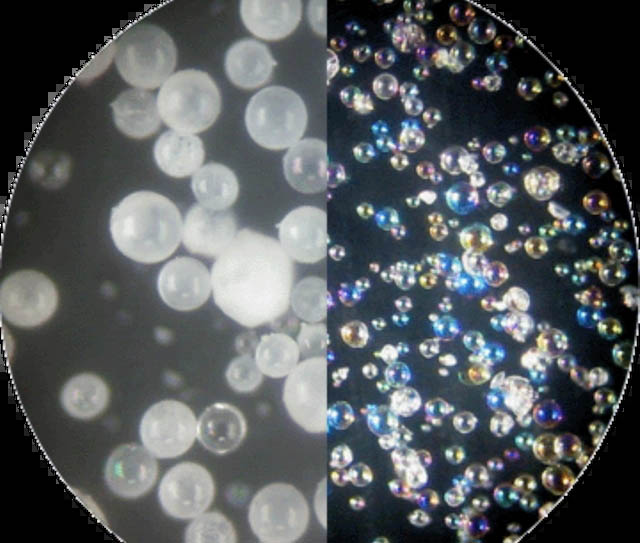
Hollow Glass Microspheres is a Free Flowing White Powder and showed to be hollow sealed sphere under microscope. Application Hollow glass microspheres have a significant effect to reduce weight and noise insulation, make the products have good anti-cracking performance and re-processing performance, is widely used in glass, steel, artificial marble, artificial agate and other composite materials, and the oil industry, aerospace , new high-speed train, car ferry, insulation coatings and other fields.

Low density drilling fluids made with hollow glass microspheres:
1) Adjustable density in a wide range
2) Incompressible and uniform in density
3) Good lubricity, Reduce drilling tool wear
4) No pollution for reservoir
5) Good stability at high temperature and pressure
6) No loss of MWD signal
7) Mud cake quality improved

Low density cement slurries made with hollow glass microspheres:
1) Density can be decreased to as low as 0.90g/cm³
2) Low porosity
3) High compressive strength
4) Good stability at high temperature and pressure
5) Low fluid loss rate
6) Adjustable thickening time

FROM:chnchemical

Hollow Glass Microspheres‘ applications are in the fields of Thermal insulation coating, putty, plastic casting polyester, FRP ,SMC, synthetic foam, adhesives, printed circuit board substrate, RTM, bowling, fan blades, & caulking materials, emulsion explosives, golf, sealant, pipeline insulation materials, artificial marble, PVC foam, low density oil drilling, light cement, and other deep-sea buoy etc.

FROM:chnchemical

Hollow Glass Microspheres Y Series are hollow glass spheres designed for use in drilling, completion, and workover fluids, as well as cement slurries in the oil and gas industry. With density of 0.20~0.60 g/cc and crush strength of 2,000 ~12,000 psi (pounds per square inch), Y Series Hollow Glass Microspheres are well-suited for use in wells from various depths.
1)Successfully and predictably reduces the control fluid density
2)Prevents or minimizes fluid loss/lost circulation and formation damage
3)Incompressible and more homogeneous control fluid properties compared with foamed and aerated systems
4)Eliminates the need for specialized equipment used in foamed and aerated systems
5)Potential for improved production efficiency, enhanced well integrity and increased well productivity

Application
Hollow Glass Microspheres’ applications are in the fields of Thermal insulation coating, putty, plastic casting polyester, FRP ,SMC, synthetic foam, adhesives, printed circuit board substrate, RTM, bowling, fan blades, & caulking materials, emulsion explosives, golf, sealant, pipeline insulation materials, artificial marble, PVC foam, low density oil drilling, light cement, and other deep-sea buoy etc.


Hollow glass microspheres ( also known as glass bubbles ) are hollow glass spheres made of chemically stable Soda-lime-borosilicate glass with thin walls(wall thickness 1~3.5μm). We have several grades available with true density ranging from 0.20g/cc~0.60g/cc, Sinosteel hollow glass microspheres can be used as lightweight functional additives for Composites,Thermal insulation paints/coatings, Sealant/adhesives, Low density cementing slurries and many more applications with very competitive quality and price.

Sinosteel Maanshan New Material Technology Co., Ltd., a wholly owned subsidiary of Sinosteel Maanshan Institute of Mining Research Co. Ltd., is a comprehensive high-tech company that specializes in research&development 、production and sales of high-performance Hollow Glass Microspheres.

Established in 1963, Sinosteel Maanshan Institute of Mining Research Co., Ltd (Hereafter, The Institute) used to be a key scientific research institute under the former Ministry of Metallurgical Industry. The Institute has been authorized to grant master’s degree (first-level discipline) by the Academic Degree Committee of the State Council since early times. The Institute, now as a national innovation-oriented company and a key high-tech company under the National Torch Program, is attached to Sinosteel Group Corporation Limited. The Institute has undertaken and completed a number of major national science and technology projects successfully, and won more than 680 awards of scientific and technological achievements at national or provincial levels by far.


Colored hollow glass microspheres add color to a product without the use of other colorants (pigments or dyes) and also offer functional benefits such as lower viscosity and improved flow. Solid polyethylene hollow glass microspheres can be manufactured in any color, including flesh tone, clear, grey, fluorescent, glow-in-the-dark and multicolor, which provides a multitude of options for color effects in a wide variety of products.

Hollow glass microspheres can be used to add saturated color, a hint of color or a sparkle to a formula. Colored hollow glass microspheres enable formulators to achieve saturated colors or desired color effects with much larger particles, which are not respirable and come in a free- flowing dry powder, ensuring a simpler formulation process. In addition, since larger hollow glass microspheres tend to not agglomerate as easily as submicron pigments, the challenge of pressed-powder agglomeration is greatly reduced.

Since creating an opaque hollow glass microsphere is almost impossible, colored polymer hollow glass microspheres are often preferred for applications requiring high color, opacity and superior coverage. However, hollow glass microspheres are preferable if maximum clarity of the sphere is desired, for example, for a soft-focus effect.

In science and technology applications color becomes one of the most important properties of hollow glass microspheres, especially when used as tracer particles that need to have high contrast and visibility in the system, such as in-vivo studies, process diagnostics and troubleshooting, contamination studies, flow visualization, and instrument calibration, to name a few applications.

This article comes from microspheres edit released

Glass bubble, made of Soda Lime Borosilicate Glass, are hollow spheres which grain size is 10-250microns, wall-thickness 1-2 microns, filled with inert air or gas.
glass bubble are produced at the high temperature of 700-800 degrees Celsius through complicated chemical and physical transformation. glass bubbles are white and the specific gravity of them is about 0.25-0.60g/cc.
Hollow glass microshpere have much merit, such as lightweight, great buoyancy, hard, rigid, waterproof, innoxious, insulative, low heat conductivity, higher mechanical strength and excellent chemical stability,etc. glass bubble surface was treated by the special way and the products are dispersed very easily in organic materials such as resin.

glass bubble are widely used in composite materials such as FRP, man made marble and man made agate. glass bubble can decrease the weight of the composite materials and the composite materials have excellent performance of sound insulation and heat preservation, and they can improve the mechanical performance of the composite materials such as strengthened rigidity, enhanced anti-impact property, excellent anti-breaking property and re-processing function.

Features of Lightweight Hollow Glass Microspheres for Paint Additives
– Light specific gravity and large volume
– High disperion and good fluidity
– Heat insulation, sound insulation
– Low rate of absorbing oil

Application of Lightweight Hollow Glass Microspheres for Paint Additives
PLASTICS: BMC, SMC, Injection Molding, Extruding, PVC flooring, Film, Nylon, High Density Polyethylene, Low Density Polyethylene, Polypropylene
CERAMICS: Refractory, Tile, Firebricks, Aluminum Cement, Insulating Materials, Coatings.
ROCK OIL: Oil well construction, Heat preservation of oil pies, Materials used again erosion
SPACE: Aerospace coatings, Aerospace composites
AUTOMOTIVE: Composites, Undercoating, Engine parts, Brake pads, Trim molding, Body fillers, Plastics, Sound proofing materials
CONSTRUCTION: Specialty cements, Mortars, Grouts, Stucco, Roofing materials, Acoustical panels.

FROM:chnchemical

Hollow glass polymeric or ceramic microspheres are used in coatings or composites and exhibit unusual mechanical and heat-insulation properties.In many countries, heat insulation by means of coatings is achieved by adding hollow or solid microspheres in acrylic-based coatings. Many coatings are developed with high absorbtivity in the visible regime and very low emissivity in the IR regime for architectural as well as industrial coatings.

Issues like stringent environmental regulations, customer requirements and competitive markets can be tackled with innovative raw material usage and developing new processes. There are many raw materials available that can be called ‘answers awaiting questions’; a good example being microspheres.

These specialty materials are used for many purposes in many diverse industries. Microspheres are innovative raw materials in the coatings industry, and are diverse because both solid and hollow formats are readily available. Solid spheres are most commonly used in reflective traffic paints where the microspheres are used as light reflectors. Hollow microspheres are small, spherical particles ranging in size from 12-300 microns in diameter, and wall thickness up to 0.1 micron. As these microspheres are hollow, the true density is very low, ranging from 0.60 g/cc to as low as 0.025 g/cc. Organic hollow microspheres are mostly composed of polystyrene, polyacrylonitrile or phenolic materials, while inorganic microspheres are glass, ceramic or made from fly ash from thermal power plants.

Glass Microspheres
Glass microspheres give high heat and chemical resistance with density ranges of 0.125 – 0.60 g/cc. The collapse strength depends directly on the wall thickness and density, thus the higher the density, the higher the strength.

Solid or hollow glass microspheres are used in various applications in the coatings industry. They are commonly used to improve the performance of epoxy primers, powder coatings, floor applications, aircraft paints and industrial coatings. Hollow spheres are used in thermal insulating coatings for construction and transportation applications, and also for acoustic insulation coatings.(4) Hollow glass microspheres with a density of 0.6 g/cc with a fine particle size distribution can be used in flat wall paint.

Plastic Microspheres
Thermoplastic microspheres are compressible hollow particles with thin shell walls having densities as low as 0.025 g/cc. As resilient plastic materials, these microspheres can deform under stress (during high shear mixing or pumping), and there is very low to no breakage. The compressible nature of plastic can absorb impact, reducing damage caused by stone chips, foot traffic or freeze-thaw cycles.

Use in Coatings
Uniform spherical-shaped microspheres have lower surface area then irregular fillers and extender pigments, which means a lower resin demand. Another benefit to the spherical shape is the ability to roll past one another, hence there is minimal impact on viscosity when they are added to a liquid. As coatings are manufactured on weight basis and sold on volume basis, microspheres are used to increase the solid content of a coating, maintaining application and flow properties. Higher-volume solids reduce VOCs, shrinkage and drying time.

Since hollow spheres lower the density of materials, they are added to coatings. If added in coatings, it will atomize better while spraying and it will give less spatter while rolling also sag less once applied. [4]

One of the most important applications microspheres have been developed for is the Space Shuttle program. When the space shuttle re-enters the earth’s atmosphere, incredible heat is generated due to increasing air friction. In order to prevent the space shuttle from burning up during re-entry, NASA scientists developed a superior insulating material using Ceramic technology. This technology can now be applied to roofs and sidewalls of buildings, piping, ducts, tanks, various storage devices, refrigerated containers, cold rooms, etc. in order to insulate them from the radiant heat of the sun and the atmosphere by using hollow ceramic spheres.

Stagnant air is a bad conductor of heat because heat is transferred by convection currents. Stagnant air inside hollow spheres acts as an insulator for heat and hence can be used as heat insulating material in coatings. This characteristic of hollow microspheres allows improved thermal and acoustic insulation properties of coatings or composites. Currently, markets taking advantage of this property include fire retardant materials, sensitive acoustic equipment, and roof coatings.

Applications of Hollow Microspheres
All Types of Roofs – Flat or Slopping, made of Concrete, Metal or Asbestos Cement,
Side Walls of Residential and Commercial Buildings, Hotels and Hospitals, Construction Office,
Roofs and Sidewalls at Process Control Rooms, Surveillance Towers, Manufacturing Plants and similar constructions and structures
Piping in Air Conditioning Systems, Steam Pipes, Thermo Fluid Pipes, Boilers
Exterior of Storage Tanks for Crude Oil, Chemicals, Solvents, Natural and Petroleum Gas, Storage Devices at Petroleum and Petrochemical Industries,
Grain Silos, Fishing Trawlers, Cold Storage, Refrigerated Trucks and Containers
Exterior Roofs of Public Transport Vehicles, Railway Passenger Coaches

Limitations
Large particle sizes of microspheres can result in surface texture, meaning gloss reduction. Today, however, fine size hollow glass microspheres are available for coatings requiring higher gloss and thin layer deposition . Microspheres have low density, which means the particles have the tendency to become airborne while being added to the batch. Also for the same reasons, floating or phase separation can occur in the finished mix.

Conclusion
Hollow micro spheres (especially glass microspheres) offer improved scrub and burnish properties, gloss, stain resistance, viscosity control, thermal insulation and sound-dampening characteristics. No other conventional additive can match the multiple performance benefits of hollow micro spheres. Their hollow structure, low density and small particle size make them ideal for use as extenders for paint formulations. With particle sizes considerably finer than previously available, hollow micro spheres can be used in thin-film coatings to improve integrity. In the case of glass microspheres, they do not absorb resin, allowing more resin to be available in film forming; the result being a tighter and more uniform film with improved durability . Opaque hollow-sphere polymeric pigments can be added to improve dry hide of coatings, which allows the paint manufacturer to reduce the level of TiO2 in coatings at no loss of performance.

Hollow Glass Microspheres H46

Hollow glass microspheres H46 is a very small particles with a higher ball—type rate. Its “ball—bearing” effect can increase the fluidity and reduce the viscosity and internal stress of the resin mixture. As a result, the composite materials produce less heat in dynamic processing, and avoiding the inadequate lubrication and the partial thermal decomposition. On the process of injection molding , they are more easily squeezed out, which not only reduce the product defect, but also improve the production efficiency.

How do you make glass microspheres?
1. Glass powder method
The glass powder method uses pre-prepared glass powder containing gases such as SO3 to pass through the flame at the temperature of 1100-1500℃. At this time, SO3 and other gases dissolved in the glass powder overflow from the inside of the glass due to the decrease in solubility and the change in the atmosphere of the kiln. At the same time, the glass powder becomes spherical under high temperature due to the surface tension. The spillage gas is sealed in the spherical particles to form hollow glass beads.
2. Spray granulation method
Spray granulation method is made in advance with special auxiliary reagent (boric acid, urea, ammonium pentaborate) aqueous solution of sodium silicate, and then through the nozzle to the solution injection into the spray dryer, is expected to drop after drying to get a certain particle size of powder particles, the final will be powder particle heating foam-forming hollow glass beads.
3. The droplet method
The liquid drop method adopts the same raw materials as the spray granulation method. The raw materials are 500 copies of sodium silicate (M (SiO2): M (Na2O) =2), and the same amount of 10% ammonium perborate aqueous solution is added. After mixing evenly, the hollow glass beads are sprayed into the spray drying tower.
4. Dry gel method
The alkyl salt was added to dilute hydrochloric acid and decompose with water. After gelation, the gel was dried in two stages at 60℃ and 150℃ and then crushed by a ball mill. After grading, the dried gel powder was obtained, which was foamed in a vertical electric furnace at 1280℃ to prepare hollow glass microspheres.

Applications of Hollow Glass Sphere :
Hollow glass microspheres are widely used in glass fiber reinforced plastic products, composite foam plastic, artificial marble, compound wood, sound insulation heat preservation material, atomic ash, deep-sea buoyancy, bowling, low-density cement, sealing material, lightweight, resin handicraft, the mural wall hanging frame, wall plate sandwich layer structure of lightweight packaging materials, electronic industry, absorbing material, lightweight concrete, such as emulsion explosive.
Hollow glass microspheres also provide a conductive coating. Conductive coatings of optimized thickness provide spherical particles with excellent conductivity and shielding properties while maintaining the weight savings associated with hollow, low-density materials. These conductive microbubbles are suitable for military applications, biotechnology, medical devices, electronics and other special industries.
Hollow glass beads have obvious weight reduction and sound insulation and heat preservation effect so that the products have good cracking resistance and reprocessing performance, is widely used in engineering plastics, insulation materials, rubber, buoyancy material, FRP, artificial marble, man-made agate, generation of composite materials such as wood, and the oil industry, aerospace, communications, 5 g new high-speed trains, cars, ships, in areas such as thermal insulation coatings, adhesives, vigorously promote the development of science and technology.

FROM:TRUNNANO